
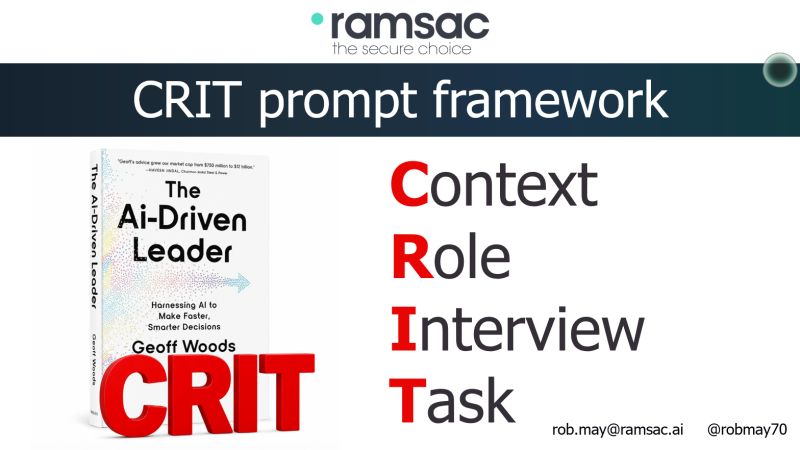
The CRIT Framework
Most people using AI are getting about 20% of what it's capable of. Not because the tools aren't powerful enough, but because the prompts aren't.
When I read "The AI-Driven Leader" by Geoff Woods, one framework in it stuck with me and I've used it ever since.
He calls it CRIT: Context, Role, Interview, Task. It's a simple structure, but it changes the quality of what you get back significantly.
Context is where most people start and stop. They describe the situation and expect the AI to fill in the rest.
But adding a Role, asking the AI to think as a specific expert, a CFO, a sceptical customer, a regulatory specialist, sharpens the output considerably.
Interview is the step people skip most often. Rather than diving straight into the task, you let the AI ask you questions first, one at a time, until it fully understands what you actually need. If you're short on time, you can say "ask me five questions, one at a time" and work through them quickly. It surfaces assumptions you hadn't noticed and gaps you hadn't considered. Then, and only then, you give it the Task.
The reason this works isn't magic. It's the same reason a good consultant asks questions before offering solutions. The more precisely you frame what you need, and who you need it from, the more useful the answer.
If your prompts are producing generic outputs, this is probably why. Try CRIT on your next one and see what changes.
And if you were wondering what book to get for your summer holiday (and you've read all of mine!), then I highly recommend Geoff's book.
Frequently asked questions
What is the CRIT prompt framework?
The CRIT framework is a simple prompt structure created by Geoff Woods in his book, The AI-Driven Leader. It stands for Context, Role, Interview, and Task. It helps users get significantly better, less generic responses from AI tools by properly framing what is needed and who the AI should act as.
What does each letter in the CRIT framework stand for?
CRIT stands for Context, Role, Interview, and Task. Context describes your situation. Role instructs the AI to adopt a specific expert mindset, such as a CFO. Interview allows the AI to ask clarifying questions one at a time before starting. Finally, Task clearly defines the actual action you want the AI to perform.
Why is the Interview step so important in the CRIT framework?
The Interview step is often skipped, but it allows the AI to ask questions one at a time before tackling the main task. This surfaces unexamined assumptions and highlights gaps in your request. By allowing the AI to gather details first, much like a good consultant, you achieve much sharper and more precise results.
How can you use the CRIT framework if you are short on time?
If you are short on time during the Interview stage, you can explicitly instruct the AI to ask you five questions, one at a time. Working through these questions quickly ensures the AI gathers the necessary details and uncovers important gaps without making the prompting process overly lengthy or tedious.
Why do standard AI prompts often produce generic outputs?
Standard prompts produce generic outputs because most people only provide basic context and immediately request a task. They fail to assign the AI a specific expert role or let it ask clarifying questions first. Without precise framing, the AI must guess missing details, leading to surface level responses rather than tailored expert advice.
You may also be interested in
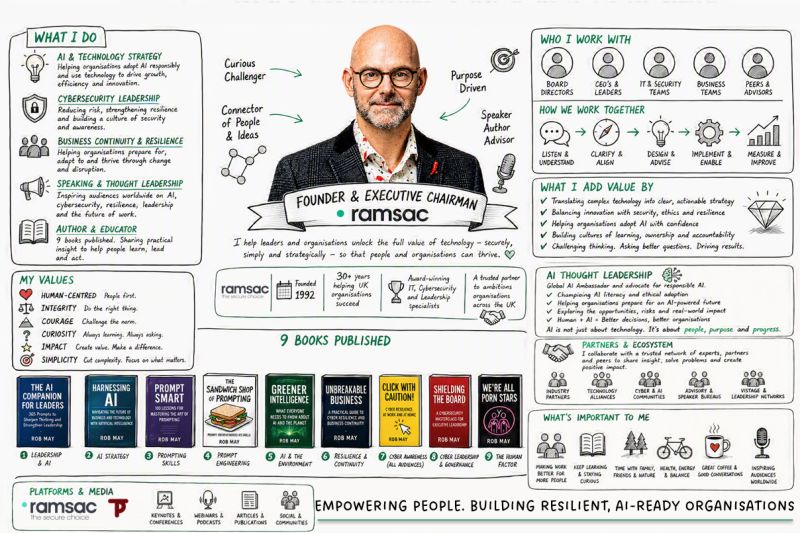
Creating a whiteboard sketch using AI
Use AI to quickly generate a whiteboard sketch which tells everyone a bit more about you and what you do.
Policy Didn't Stop These Breaches. Judgement Would Have.
Why charity AI policies aren't preventing data breaches. Real cases, the 20:60:20 rule for safe AI use, and what trustees now need to know about AI governance.
Never miss an article
Get new articles by email
Whenever I publish something new on AI, cybersecurity and cyber resilience, I'll send you a link. No newsletters, no selling, and one click to stop at any time.
Your address is used only to send you new articles. See the privacy notice.