
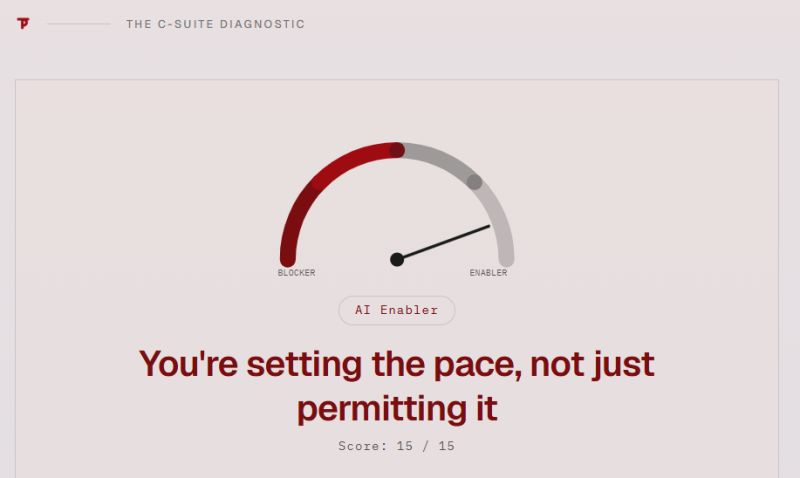
AI Blocker Diagnostic Next Steps
Nobody who has taken the AI enabler or blocker diagnosis test walked away neutral about their result. The enablers wanted to talk about it. The blockers went quiet.
That reaction is the interesting bit, more than the dial itself. So here's the follow-up, what to actually do depending on where you landed.
If you came out as an active blocker, don't spiral. You got there by being careful, and caution isn't the enemy. But find one idea currently sitting in a review process, something genuinely low risk, and let someone just try it this week. Not a pilot. Not a committee. Just try it.
If you're a blocker in governance clothing, the fix starts with a question, not a policy change. Ask your best people whether they use AI more confidently at home than at work. Then ask them why. You'll learn more from that conversation than from any risk framework.
If you're an emerging enabler, you're closer than you think. Find the one use case your process is treating as high risk when it clearly isn't, and fix that mismatch. That's usually where good ideas are quietly dying.
And if you came out as an enabler, don't get comfortable. Being an enabler yourself and leading an enabling organisation are two different things. Ask someone two levels down what's actually stopping them trying something. You might not like the answer.
This bit doesn't need an AI strategy document. It needs one thing, done this week, that you can point to afterwards and say, that's what changed.
If you haven't tried it yet, it takes two minutes, no sign up, no stored data, and you can save your results as a pdf to action later - give it a go: https://thoughtprovoked.co.uk/guides/ai-enabler-or-blocker
Frequently asked questions
What should active blockers do after taking the diagnostic test?
Active blockers should not spiral, as caution is not the enemy. Instead, they should identify a genuinely low risk idea currently stuck in a review process and let someone test it this week. It should be a direct trial rather than a full pilot or committee review, allowing immediate practical progress.
How can leaders address AI blockers hiding behind governance?
Leaders who act as blockers under the guise of governance should start with a conversation rather than a policy update. Ask top employees if they feel more confident using AI at home than at work, and explore the reasons why. This conversation yields far more practical insight than any formal risk framework.
What action should emerging enablers take to move forward?
Emerging enablers should look for a specific use case that internal processes treat as high risk when it clearly is not. Correcting this risk mismatch helps rescue good ideas that are quietly dying in review. Fixing one misclassified task is often all it takes to make real progress this week.
Why is being an AI enabler different from leading an enabling organisation?
Being an individual enabler is distinct from creating an enabling organisation. To lead effectively, enablers must ask employees two levels down what is actually preventing them from trying new ideas. Uncovering these hidden operational barriers matters more than drafting a formal AI strategy document or relying on personal enthusiasm.
How long does the AI diagnostic tool take and how is data handled?
The AI enabler or blocker diagnosis test takes just two minutes to complete. It requires no sign up and stores no personal data. Users can also save their diagnostic results directly as a PDF document to help action their specific next steps during the week.
You may also be interested in
Should Your IT Support Company Block the Claude AI Microsoft 365 Connector?
Why do IT support companies keep blocking the Claude AI Microsoft 365 connector over data security fears? Here's what it actually accesses, why some MSPs default to no, and how to make a governed decision instead.
Five things every business should do before deploying an AI agent
Building AI agents and workflows? Here are five things every business should do before deploying, drawn from the world's first AI governance standard.
Never miss an article
Get new articles by email
Whenever I publish something new on AI, cybersecurity and cyber resilience, I'll send you a link. No newsletters, no selling, and one click to stop at any time.
Your address is used only to send you new articles. See the privacy notice.