
Why you need AI principles before you create an AI policy
Most AI policies are out of date before they’ve been signed off. A tool adds a new feature, someone in finance finds a clever use for it on a Tuesday afternoon, and the policy that took three months to write has nothing to say about it.
That gap matters more now than it did a year ago, because AI is moving from answering questions to doing work. When a tool can draft the reply, update the record and trigger the next step, your people are making judgement calls all day, and most of them will never reach a policy owner. What they have in those moments is whatever they understand about how the organisation thinks. If nobody has told them, they’ll either guess or stop, and neither is what you want.
Principles do what policies can’t
A policy tells people what to do in situations you’ve already predicted. A principle helps in the ones you haven’t. I’ve always liked the phrase “govern what matters, don’t slow what works”, and principles are the practical way to do it. They give people enough direction to move quickly on the everyday work, and a clear signal for when something deserves a pause.
They also do something quieter. They show what leadership actually believes about AI, which is usually what people are most nervous about. Is this about cutting jobs? Am I allowed to experiment? Will I get into trouble if I get it wrong? A good set of principles answers those questions before anyone has to ask them.
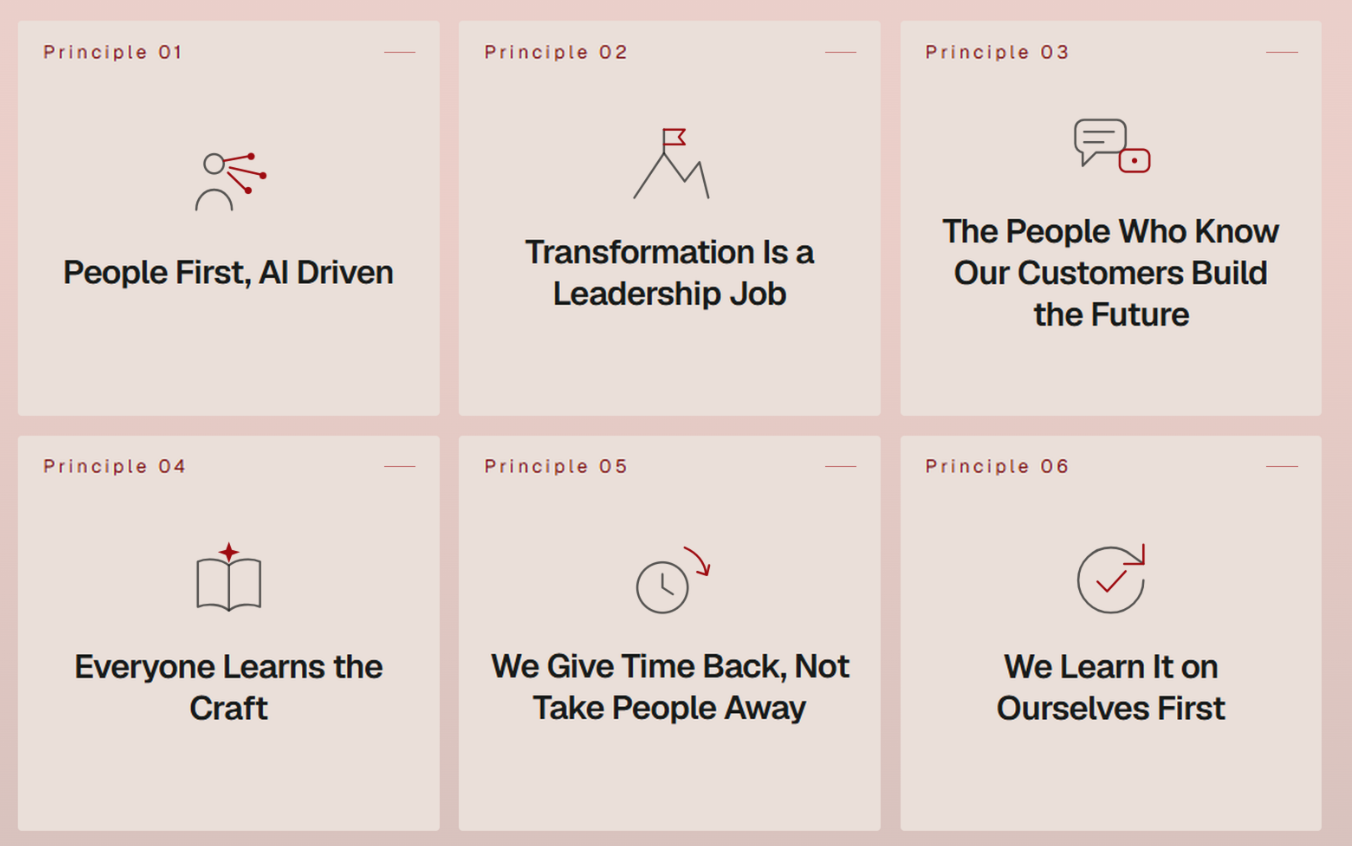
At ramsac we’ve settled on six, and you can see them in full on the Thought Provoked site. Here’s how I think about each one.
The six, and what sits behind them
-
People First, AI Driven. After thirty-four years of helping organisations move from paper to digital, servers to cloud and the office to working from anywhere, one pattern has never changed: having the newest technology mattered far less than having people who understood it and trusted it. AI is the accelerant, but the ambition, judgement and relationships stay human.
-
Transformation Is a Leadership Job. This is the one I’d put at the top for any board. AI isn’t an IT project. It needs vision, sponsorship and a willingness to change how decisions get made, and it moves fastest, and most safely, when the people at the top use the tools, ask the questions and set the guardrails themselves.
-
The People Who Know Our Customers Build the Future. The best ideas rarely start in the boardroom. They start with whoever answers the calls, runs the projects and solves the awkward problems, long before they show up in a strategy deck. So we give those people the tools, the time and the permission to experiment, and permission is the word I’d underline.
-
Everyone Learns the Craft. AI literacy shouldn’t be a specialism reserved for a technical few. From the newest joiner to the most senior leader, everyone learns how to prompt, how to question what comes back and how to use these tools responsibly. A confident, curious workforce does more for the value you get from AI than any single piece of software.
-
We Give Time Back, Not Take People Away. If I had to pick the principle that matters most for trust, it would be this one. We measure success in capacity, quality and customer value, not in fewer people. If staff suspect AI is a headcount exercise in disguise, they’ll quietly resist it, and it’s hard to blame them. If they see it removing the repetitive and the energy-sapping, they’ll lean in.
-
We Learn It on Ourselves First. Every workflow, agent and policy we recommend has been tested inside ramsac first, with our own teams, our own data and our own mistakes along the way. Some people call it eating your own dog food, we prefer to think of it as drinking our own champagne. It also keeps us honest, because it’s hard to oversell something you’ve watched go wrong in your own business.
Writing your own
Please don’t copy ours! The value comes from deciding what you actually believe about people and AI and then saying it plainly. A few tests help. Could someone say each principle out loud in a team meeting without it sounding like a slogan? Would it help in a situation nobody predicted? Does at least one of them say something about what leadership will do, not just what staff should do? And would it still hold if your main tool changed next month?
Aim for five or six, then pair them with a short, practical policy covering the genuinely sensitive areas such as data, accountability and high-risk decisions. The principles set the direction; the policy marks the edges.
Here’s a question to finish on. If someone in your team had to decide tomorrow whether to use AI on something you’ve never thought about, what would they be relying on? If the honest answer is guesswork, that’s your gap, and it’s a much easier one to close than most people think.
Further reading
-
OECD AI Principles, the first intergovernmental standard on AI, adopted in 2019 and updated in May 2024: https://oecd.ai/en/ai-principles
-
ramsac post on joining the Global Council for Responsible AI: https://www.ramsac.com/blog/why-responsible-ai-matters-rob-may-on-the-global-councils-mission
-
Our own AI story, with the six principles in full: https://thoughtprovoked.co.uk/our-story
Frequently asked questions
Why does an organisation need AI principles before an AI policy?
AI tools evolve rapidly, making traditional policies outdated quickly. While policies address predicted situations, principles guide employees through unpredicted, everyday decisions. Principles provide practical direction, demonstrate what leadership genuinely believes, and allow staff to move quickly without guessing or stalling when faced with new technology.
How do AI principles differ from an AI policy?
A policy tells people what to do in situations an organisation has already predicted, setting clear boundaries around sensitive areas like data and high-risk decisions. A principle helps guide judgement in unpredicted situations. Principles set the overall direction, while a concise policy marks the necessary edges.
Why is AI transformation considered a leadership job rather than an IT project?
AI transformation requires strategic vision, board sponsorship, and changes to decision making processes. It is not merely a software rollout. Transformation moves fastest and most safely when senior leaders actively use the tools themselves, ask questions, set guardrails, and lead the cultural shift from the top.
How can leaders reassure staff that AI will not replace their jobs?
Leaders can reassure staff by committing to principles that measure success in capacity, quality, and customer value rather than reduced headcount. When employees see that AI is meant to remove repetitive, energy sapping tasks to give them time back, they are far more likely to embrace the technology.
What makes a good set of AI principles for a business?
A good set consists of five or six plain spoken statements reflecting true organizational beliefs. Principles should sound natural when spoken in meetings, remain valid if tools change, guide leadership actions as well as staff behaviour, and offer practical guidance for situations that no one predicted.
You may also be interested in

Does your AI policy reflect your company values?
Most businesses have a set of company values and a growing number have an AI policy, but few have checked whether one reflects the other. Drawing on a session at the ramsac AI Summit with Malak Sadek from Cambridge University, this article looks at how to turn values like agency, inclusion and respect into practical AI decisions, and the questions to ask of your own policy.
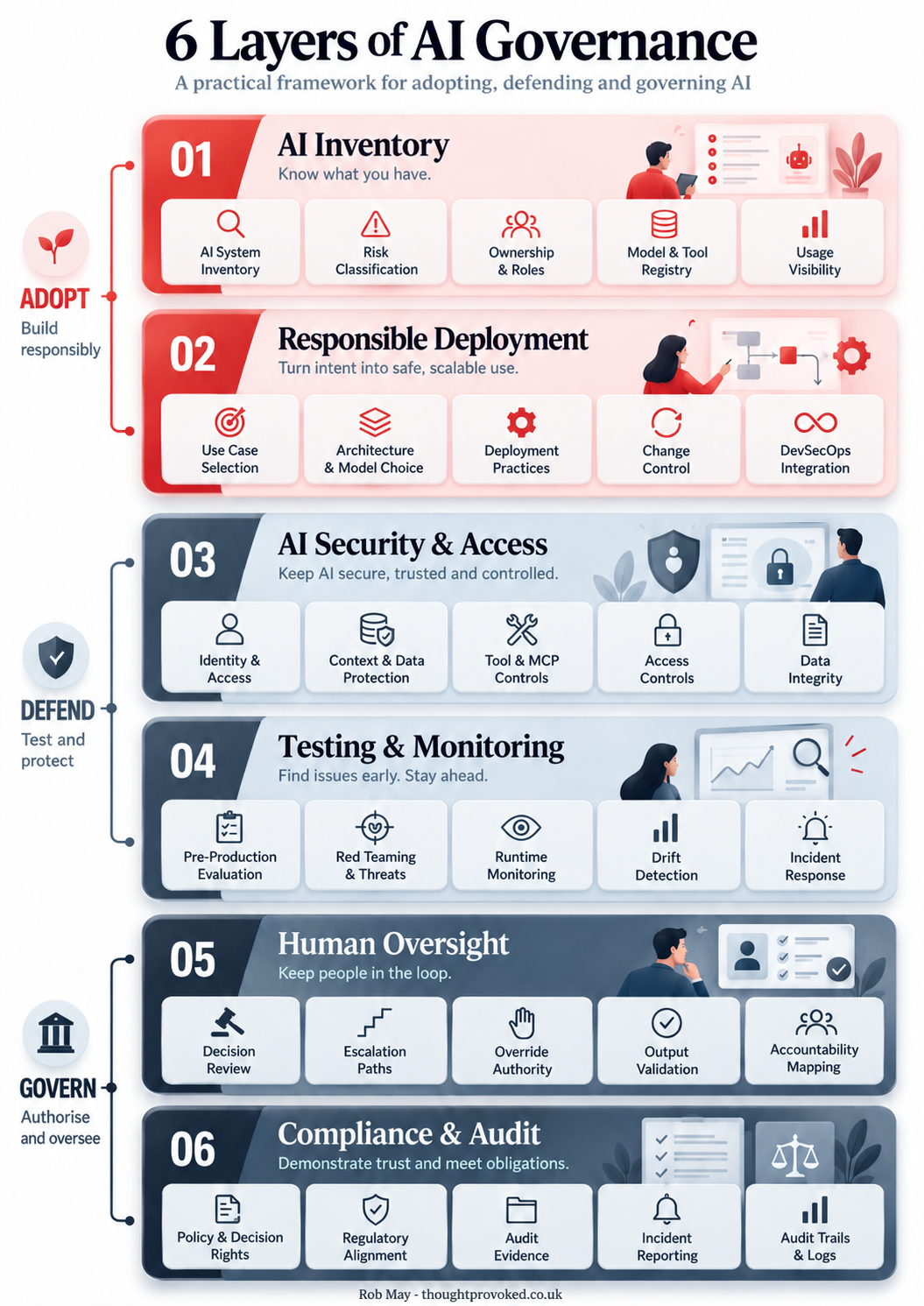
Six Layers of AI Governance: A Framework for Getting It Right
AI governance doesn't have to mean slowing everything down. This practical six-layer framework covers everything from AI inventory and responsible deployment through to human oversight and compliance, giving you a clear map of where your organisation stands and where the gaps are.
Never miss an article
Get new articles by email
Whenever I publish something new on AI, cybersecurity and cyber resilience, I'll send you a link. No newsletters, no selling, and one click to stop at any time.
Your address is used only to send you new articles. See the privacy notice.