
Does your AI policy reflect your company values?

Most companies have a set of values. They’re on the website, on the wall in reception, and probably in the onboarding pack. A growing number also have an AI policy. What’s rare is anyone putting the two side by side and asking whether the second reflects the first.
That was a big takeaway for me from a session at the recent ramsac AI Summit, where Owen Brooks, our AI director, spoke with Malak Sadek from Cambridge University about AI adoption. Malak’s work centres on human-inspired AI, and her starting point is refreshingly simple. If AI is going to work in a business, it has to take something from people and give something back to them.
Taking from people and giving back
Malak described two common ways this goes wrong. In the first, a team does excellent research with the people who’ll use a system, builds something that fits their workflow, and then ships it and forgets about it. In the second, a business only looks at the impact once the system is live and finds it’s being used to monitor people or micromanage them, or that it’s replacing someone, without anyone having asked whether it was valuable to them in the first place. Both are half a job, and human-inspired AI means doing both halves.
She also made a point about who’s in the room when these decisions get made. She told a story about a banking chatbot, built before the current generation of models, that handled “I lost my wallet” perfectly and had no idea what to do with “I lost my purse”. The team building it was entirely male and nobody had thought of it. It’s a small example, but a good reminder that values like inclusion don’t end up in a product by accident, they end up there because someone with a different perspective was around to spot the gap.
The gap between a value and a decision
Malak’s lab uses an approach called value sensitive design, and she said the place most organisations fall down is the step between stating a value and doing something concrete with it. It’s easy to say you value privacy or inclusion. It’s much harder to work out what that means for a feature, a configuration or a decision about which tool to buy.
She gave an example from a workshop with a team building virtual reality office spaces for new-hire induction days. Values went up on sticky notes, and at first the team felt a value like identity had nothing to do with them. After some discussion they came up with something very practical: instead of one generic default avatar, they could offer avatars that reflected the people actually being hired, so a new starter could walk in and see someone like themselves. A fairly abstract word became a specific design decision.
That’s the exercise I’d suggest for any AI policy. Take each of your values and ask what it would mean in practice for how AI gets chosen, configured and used.
Agency is a value too
Agency came up repeatedly in the session. Malak referred to self-determination theory, which says that supporting someone’s wellbeing means supporting their sense of agency, their competence and their connection to other people.
She shared a study of two versions of an investment recommendation tool. One collected the user’s information and delivered a recommendation with an explanation, while the other guided people through the thinking and left the final choice to them. Tested with hundreds of people, both groups made similar financial decisions. The difference was how they felt afterwards, because the people who had worked it through themselves were more satisfied and felt they had learned something.
I think that matters for anyone designing AI workflows. Convenience and efficiency are real benefits, but something is lost when a tool does so much that people never feel the satisfaction of effortful work. The aim is to keep the gains while leaving room for people to think.
What this looks like in a policy
Owen described the policy we published at ramsac. The message to the team was that we expect you to use AI tools every day, and we also expect you to own the outcome of your thinking. Used well, AI takes out the mundane and helps people move faster. Used badly, it pushes work onto someone else, like the colleague who receives a long AI-generated email from someone who previously wrote two lines. Owen’s test was that if AI makes your life faster but your colleague’s slower, that’s a net loss.
That’s a value, respect for each other’s time and accountability for your own work, turned into something people can actually follow. He also asked a question I’d encourage every leader to try. If you asked one of your team whether using AI is supported or condemned in your business, what would they say? Too often the honest answer is that it counts against you, because it suggests cutting corners. No policy document fixes that on its own, but the policy is a good place to say clearly what you actually want.
Where to start
Malak’s advice was to start from the bottom up rather than the top down. Begin with the values of the team, work out which of them AI could support, and ask people which tools they’ve tried and which they’ve disliked. That protects the sense of agency that mandates and blanket bans tend to destroy, and it shows you what’s already happening.
Two other practical points. Someone needs to own it, and she mentioned IKEA having a dedicated person to think about whether the digital tools they use are accessible, inclusive, ethical and responsible. The alternative is to make it everyone’s job by giving people a way to say which tools they use, what’s working and what they’d suggest. And it needs to keep going beyond the start, with checkpoints to see whether the decisions you said you’d make were actually made, and values translated into things you can measure over time.
Questions to ask of your own policy
If your AI policy is mainly a page of what staff can and can’t do, hold it up against your values. Does it say anything about how you treat customers, colleagues and each other? Does it leave people room for judgement? Was it written with your team or at them? Did anyone who actually uses AI help shape it?
If the answers are uncomfortable, that’s useful information, and fixing it doesn’t need a new system. It needs a conversation, ideally one that starts with the people doing the work.
Frequently asked questions
What is human inspired AI and why does it matter?
Human inspired AI focuses on taking something from people and giving something back to them. According to expert Malak Sadek, AI adoption fails when businesses build tools without involving users or monitor impact only after deployment. True human inspired AI involves research with users during design and assessing the human impact after launch.
How can businesses translate abstract company values into practical AI decisions?
Organisations can use value sensitive design to bridge the gap between stating values and choosing or configuring AI tools. For example, a team creating virtual reality onboarding spaces translated the abstract value of identity into practical design by offering diverse avatars. Leaders should take each company value and define its practical meaning for AI workflows.
Why is maintaining employee agency important when designing AI workflows?
Supporting employee agency, competence, and connection improves wellbeing and satisfaction. Studies show that when AI tools guide users through thinking rather than making choices for them, people feel more satisfied and learn more. While efficiency is valuable, AI should leave room for human thought, so employees retain a sense of achievement and ownership.
What makes an effective AI policy according to ramsac?
An effective AI policy aligns daily tool usage with company values like accountability and respect for time. At ramsac, staff are expected to use AI daily while owning their work outcomes. AI should eliminate mundane tasks, but if using it saves time for one person while slowing down a colleague, it results in a net loss.
Where should leaders start when aligning their AI policy with company values?
Leaders should start from the bottom up by consulting their team about existing tools, values, and preferences. Assigning clear ownership, such as a dedicated ethical AI role or a shared feedback process, helps maintain accountability. Organisations must also establish ongoing checkpoints to measure whether values are consistently translated into practical decisions over time.
You may also be interested in

Five Reasons Leaders Need to Use AI Personally Before They Lead On It
Before you lead on AI, use it yourself. Five reasons why hands-on experience makes you a better, more credible decision-maker.
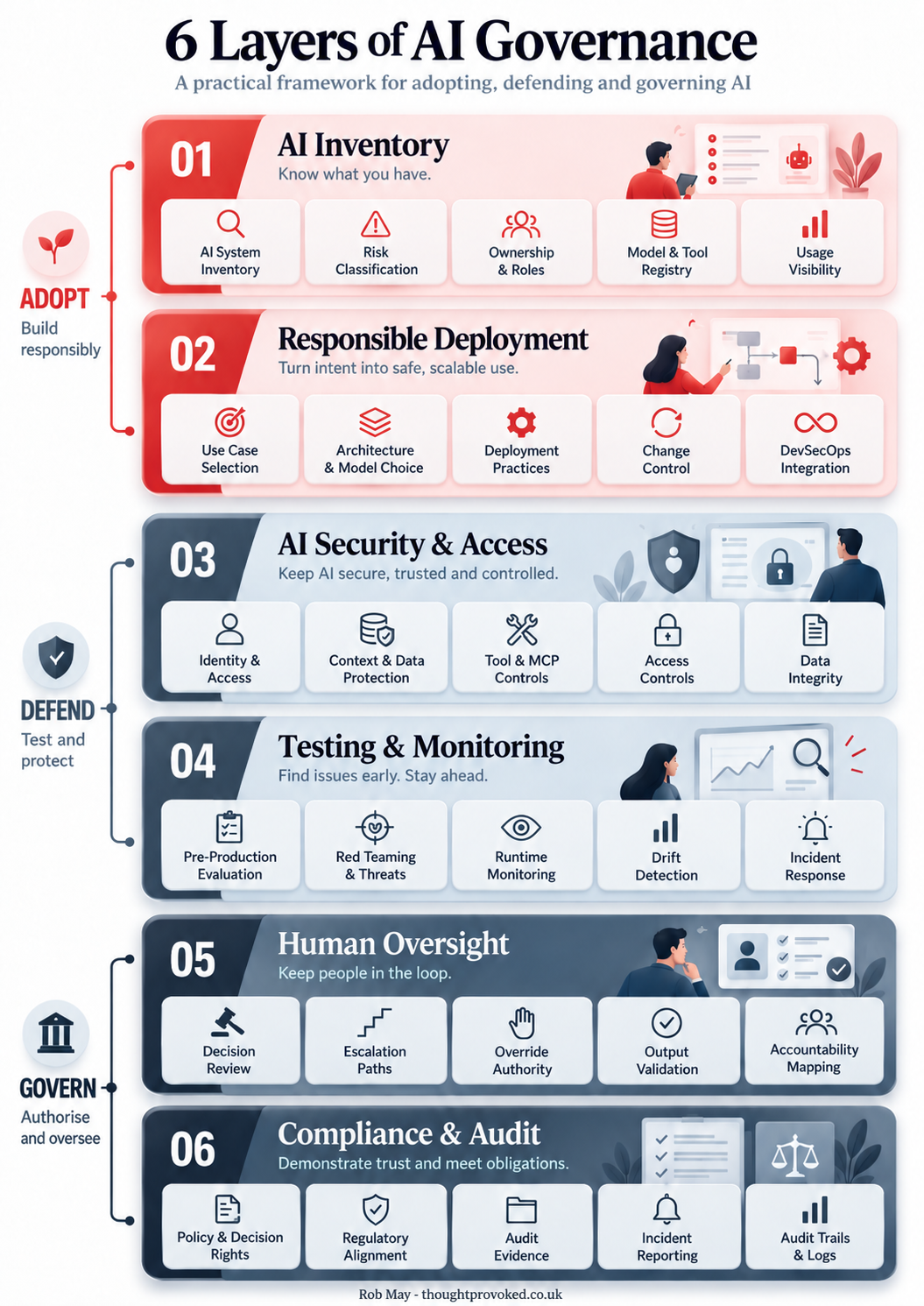
Six Layers of AI Governance: A Framework for Getting It Right
AI governance doesn't have to mean slowing everything down. This practical six-layer framework covers everything from AI inventory and responsible deployment through to human oversight and compliance, giving you a clear map of where your organisation stands and where the gaps are.
Never miss an article
Get new articles by email
Whenever I publish something new on AI, cybersecurity and cyber resilience, I'll send you a link. No newsletters, no selling, and one click to stop at any time.
Your address is used only to send you new articles. See the privacy notice.