
The AI footprint calculator.
There's a lot of noise around this subject, and not much of it is accurate. Social media is full of claims about AI's energy use that range from wildly exaggerated to confidently wrong, and a lot of young people in particular pick these up and repeat them as fact. A single AI image isn't secretly boiling the ocean, but AI use at scale genuinely isn't free either. The truth sits somewhere in the middle, and it's more specific and more useful than either extreme.
I built this tool because I got tired of guessing, and tired of watching other people guess too. It's based on the EcoLogits methodology, tuned to UK grid figures, with the full working shown below so you can see exactly where the numbers come from rather than just taking my word for it.
AI footprint calculator
What does your AI use actually cost?
Built on the EcoLogits methodology: energy scales with how much a model writes, not what you type in. Figures are estimates, not precise measurements.
The everyday assistant most people use by default for general chat and work tasks. Pick this if you're not sure.
e.g. Claude Sonnet, GPT-4o, Gemini Pro
~400 output tokens
125 g CO2e/kWh
Energy / day
5.8
Wh
Carbon / day
0.7
g CO2e
Water / day
0.01
litres
Over a year
Roughly the same as, per day
- 0.1 kettle boils
- 0.5 full phone charges
- 6 metres in an average petrol car
- 33 metres in an average EV
Methodology and sources
Energy per prompt follows EcoLogits: output tokens x an energy-per-token rate for the model's weight class, plus a 20% allowance for embodied hardware emissions on top of the electricity figure. This build uses three illustrative weight classes rather than named-model coefficients, since those change with every model release.
Grid carbon intensity uses Ember's 2024 Global Electricity Review and Our World in Data figures (UK 125, EU 215, US 380, world 480, China 580, India 700 g CO2e/kWh).
Water uses a combined consumptive estimate of ~2 litres per kWh, covering data-centre cooling and power-plant evaporative cooling (NREL puts power-plant cooling alone at ~1.8 L/kWh).
The EV comparison uses energy directly (~3.5 miles per kWh, an average figure across current EVs) rather than carbon, since an EV's emissions come from grid electricity, the same source as an AI query's. The petrol comparison uses carbon instead, since a petrol engine's emissions come from combustion, not the grid.
For production-grade accuracy, replace the weight-class table with live output from the EcoLogits library (ecologits.ai), which derives per-model figures from parameter-count estimates and updates as models change.
Want to go deeper?
Understand the real environmental impact of AI.
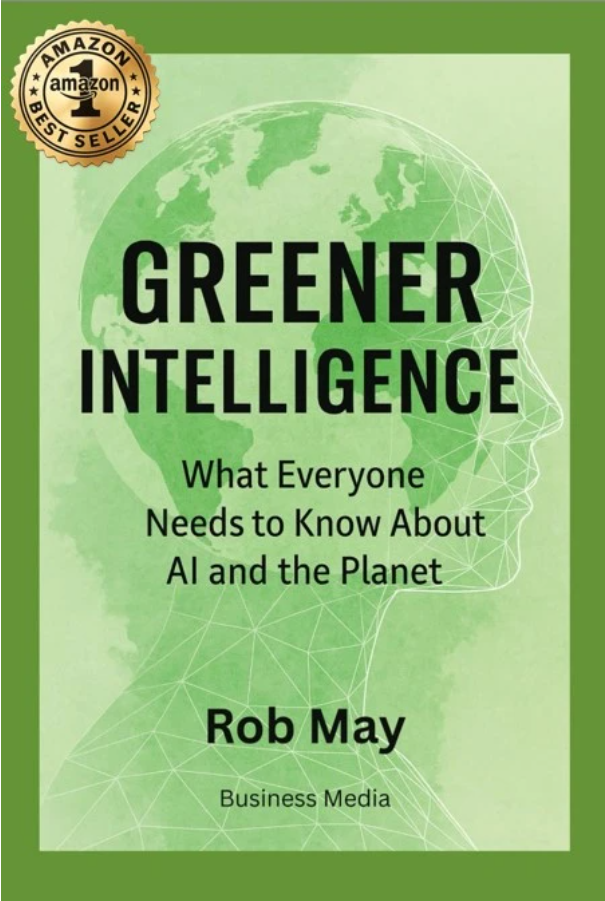
If you want to know more about the environmental impact of AI and some of the myth busting and research around this subject, read Rob's book Greener Intelligence.
Read about Greener Intelligence